
TTSapi
Turn a speech model into a usable API.
The verifier parsed the Python AST and dashboard JSON without loading weights or running inference. No latency or voice-quality measurements are published.
Origin and contribution
TTSapi adapts StyleTTS2 into an HTTP speech-synthesis surface. The model, training modules and original research belong to StyleTTS2’s authors; my contribution here is service adaptation and API integration.
The engineering problem is turning inference into an operation with parameters, authorization, concurrency control, response format and diagnostics. This page does not attribute model creation or researchers’ published results to me.
Loading and devices
TTSService selects CUDA when available and CPU otherwise. Its cache organizes models by name and device, avoiding unnecessary reloading in the same process. Configuration, checkpoints and auxiliary modules prepare inference.
torch.inference_mode reduces training-related work; mixed precision depends on GPU and configuration. These paths are implemented without a project benchmark proving acceleration on every device.
Synthesis and audio contract
The synthesis route receives text, model, diffusion parameters, format and a saved voice or reference audio. Reference input is read and converted to mono before style representation.
Responses provide audio bytes with corresponding media types. WAV, MP3, FLAC and OGG are delivery formats; format support does not imply measured perceptual quality or response time.
Concurrency, jobs and memory
A semaphore serializes shared inference work. The job endpoint launches a thread and records queued, running, completed or failed states in a local dictionary, separating submission responses from audio production.
State and results are not a durable queue. Restarting loses jobs; per-request threads also need bounds. The direct route performs synchronous work inside an asynchronous handler, an important capacity-development concern.
Voices, authentication and limits
The service lists, creates and removes voice presets, storing style representations for reuse. JWT bearer controls protected routes; an identity-based limiter tracks calls within a time window.
Production credentials and policies must replace development defaults. In-memory rate limits do not coordinate replicas, and preset names and uploads require additional validation before public exposure.
Observability, verification and next steps
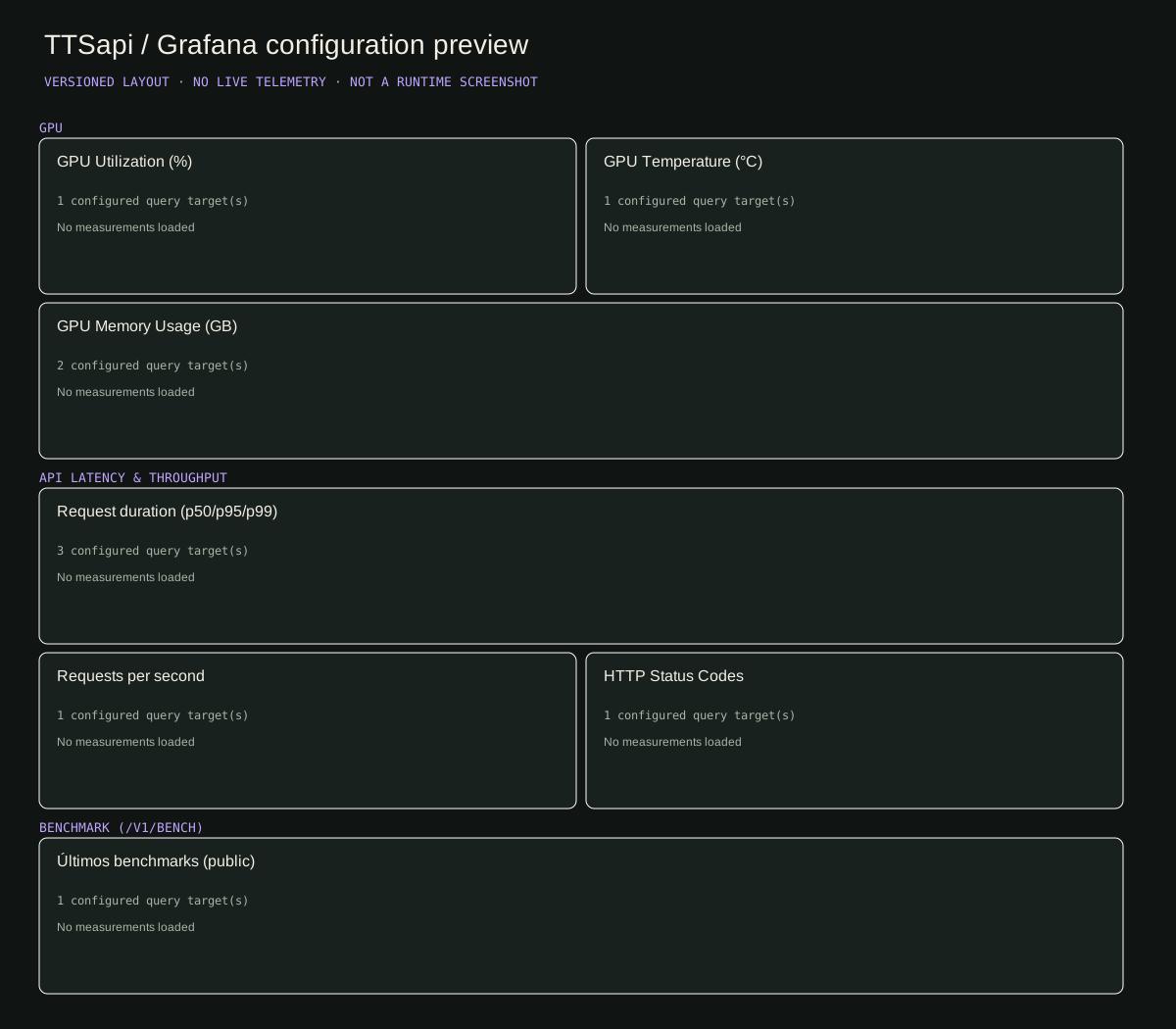
Prometheus instruments the API; GPU metrics track memory, utilization and temperature when NVML is available. Health and benchmark routes support diagnostics; Docker and monitoring configuration organize the environment.
This review inspected the service without downloading or running weights, synthesizing audio or measuring GPU behavior. Next steps include a bounded durable queue, isolation of blocking work, input validation and automated HTTP-contract tests.